Field-Sales & Commercial Operations Platform
Offline-first platform for field sales reps with bidirectional 1C ERP integration, KPI, management BI, forecasting and merchandising AI. 98% of the company's ERP orders went through it.
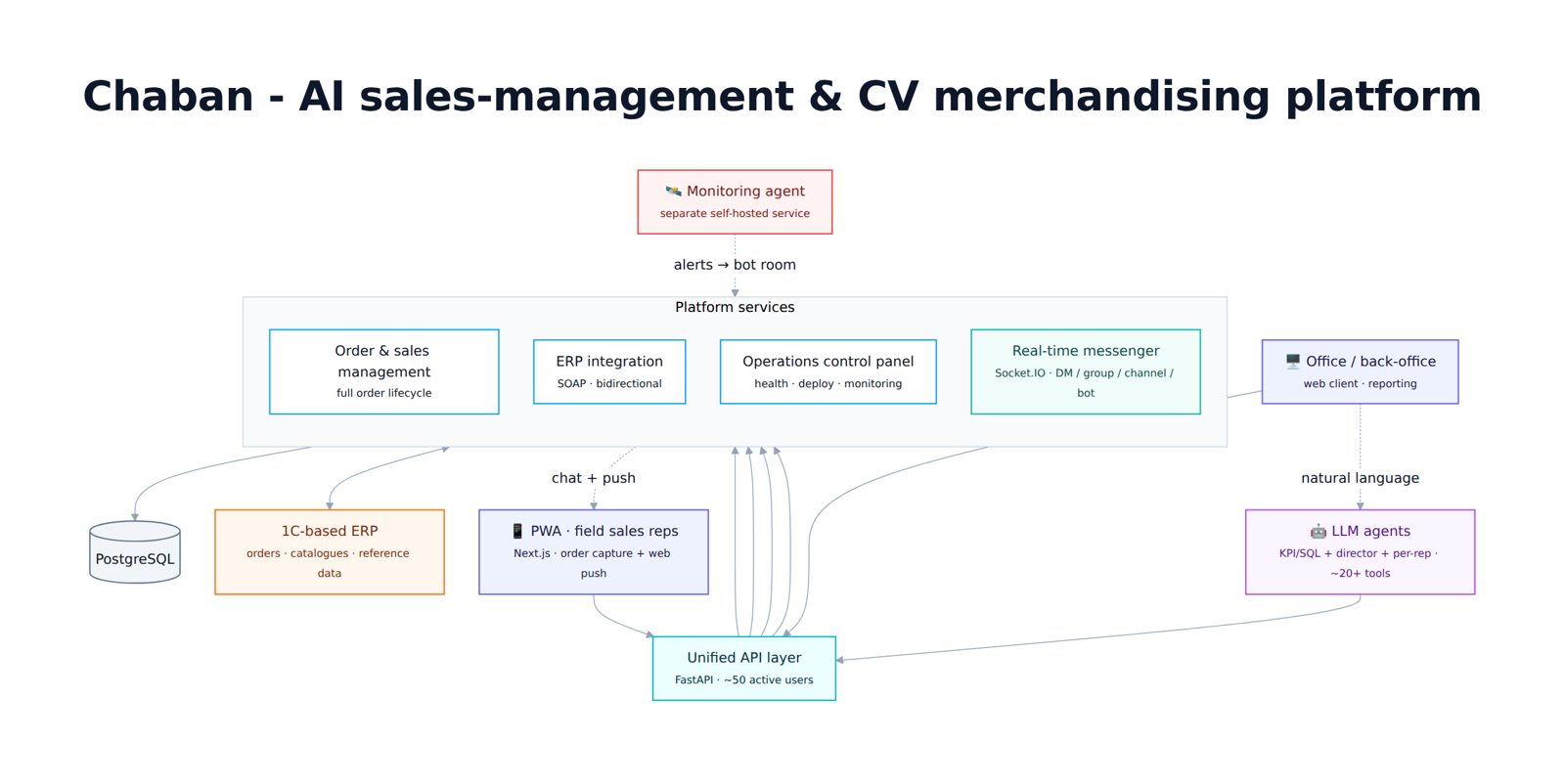
What the platform is
AI Chaban2 is primarily a field-sales and commercial-operations platform, not an AI demo. Its production core is the daily workflow of field sales representatives: routes, GPS-stamped visits, orders, cash receipts, returns, customer debt, stock visibility, audits and notes — synchronized with 1C ERP and available offline.
Above that transactional layer sit:
- a 12-scheme KPI and motivation engine;
- a 13-tab management BI suite;
- daily demand forecasting and planning support;
- a production computer-vision merchandising pipeline;
- self-hosted LLM agents and infrastructure monitoring.
By August 2026, 98% of company orders in 1C carried a platform-generated identifier — about 9k orders/month — making Chaban2 the primary order-entry channel for the commercial team.
Users & scale
- 42 accounts, including 21 active field reps, 4 supervisors, 3 merchandisers, managers, analyst, directors and platform administrators.
- Approximately 1,500 active retail outlets in a typical month.
- 9–11k orders/month in the ERP; 8,699 platform orders during 1–27 Aug 2026.
- About 13k GPS-stamped visits/month; 50k+ visits recorded in total.
- 30k+ cash receipts and ~10k returns posted through the platform since early 2026.
- 103 GB PostgreSQL, approximately 278M rows across the production database.
- 6k+ merchandising photos, ~320k OCR calls, one H200 used for self-hosted AI inference.
Field Sales
The PWA is the working application for field sales representatives. It supports:
- daily route and customer list;
- mandatory visit start/end with GPS before order entry;
- customer card with debt and unpaid invoices;
- product catalog, price types, discounts, agreements and VAT;
- warehouse availability;
- order creation, editing and history;
- cash receipt creation with FIFO allocation against invoices;
- product returns by invoice or manually;
- OOS marks and shelf-price capture;
- store photos and store attributes;
- outlet audit checklist;
- notes, surveys and Web Push reminders for unsent documents;
- personal KPI / plan-vs-fact views and online chat.
Orders, cash receipts and returns are posted from the platform into 1C ERP through SOAP services.
Offline Mobile
The field-sales PWA is local-first, not just an application shell with cached pages.
Dexie / IndexedDB stores:
- clients;
- SKUs and prices;
- price types, discounts and agreements;
- unpaid invoices and debt-related data;
- order, receipt and return drafts;
- visit/GPS events and notes;
- a typed transactional outbox.
A 13-step prefetch downloads working reference data before field use.
The outbox handles
order | receipt | return | visit_start | visit_end | client_gps
with exponential backoff, 20 attempts, dead-letter state, send locks and
UUID request IDs. Server-side duplicate controls protect document
posting.
45.8k of 46.5k recorded platform orders were created in offline mode. Reps can continue the core sales workflow without connectivity; KPI and chat remain online-only.
KPI & Motivation
Twelve production motivation schemes are computed from ERP-backed sales, debt and planning data. They cover areas including:
- overdue receivables / debt;
- returns;
- sales plans by product category;
- distribution / MML;
- supplier programs;
- contract programs;
- special commercial tasks;
- total compensation calculation.
Thresholds are editable in the UI, field reps see their own results on mobile, and supervisors / managers receive role-scoped views. A rep rating provides plan-attainment comparison.
BI & Management Analytics
The management dashboard contains 13 production analytical areas with common filters and role/team scoping:
- sales overview: volume, revenue, gross profit, plan %, active customers;
- plan / fact and motivation;
- forecast;
- service level and under-fulfilment reasons;
- geographic / district analysis;
- customer clusters A–F;
- visit map and route coverage;
- ABC/XYZ product analysis;
- receivables aging;
- returns by reason / rep / product / customer;
- store-card completeness;
- churn / customer-risk analysis;
- configurable pivot/report builder.
The platform can also generate management PPTX reports. Dashboard query results are cached in Redis for 180 seconds; supervisors are scoped to their own teams.
Forecasting & Planning Engineering
Forecasting is a separate versioned data pipeline, not a single Prophet notebook.
The scheduled path starts from daily order history and produces a demand forecast per active SKU. The current baseline model is Prophet, but the surrounding engineering is at least as important as the model itself.
Forecast inputs & model safeguards
The pipeline combines:
- daily SKU order history over a configurable training window;
- regional holidays;
- SKU-level promotions / lift factors;
- weather regressors where forecast data is available;
- active-SKU filtering so dead catalog items do not consume the run.
Before fitting, extreme demand spikes can be capped with an IQR-based rule. For shorter histories the model can disable yearly seasonality and tighten trend flexibility rather than extrapolating a weak long-term pattern. Forecast outputs are clipped at zero before publication.
Versioned runs
Forecast executions have explicit run metadata rather than silently overwriting yesterday's result:
run_id + run_date + version + run_type + status
The run record can also keep execution statistics such as SKU count, record count, date range and runtime. This makes a forecast reproducible enough to compare versions and diagnose a bad run instead of treating “the forecast” as one mutable table.
Walk-forward backtesting
A dedicated as-of / walk-forward backtest replays historical forecast dates without modifying the live forecast tables.
Evaluation includes:
- WAPE;
- sMAPE;
- total forecast-vs-fact delta;
- category-level error breakdown;
- over-forecast analysis and candidate category caps.
Using as-of dates is important because customer/SKU profiles and input data must be computed from the information that would actually have been available at that historical point rather than leaking future state into evaluation.
Top-down customer allocation
The SKU-level forecast can be allocated down to customers using recent demand profiles instead of training a separate unstable model for every customer × SKU combination.
The allocation layer includes recency-aware weighting and batch-size heuristics with fallback levels such as customer/category and SKU-wide history. The same code path understands simulation/as-of runs so backtests do not accidentally use today's customer behavior.
Simulation, adjustment & operations
The repository also contains explicit simulation/versioning and adjustment stages around the base forecast, plus scheduled execution and alerting. This allows changes to forecast rules to be tested as pipeline changes rather than immediately replacing the published output.
A simplified engineering flow is:
flowchart LR
    A[Orders history] --> B[Feature / input preparation]
    C[Holidays / promotions / weather] --> B
    B --> D[Prophet per active SKU]
    D --> E[Base forecast]
    E --> F[Adjustment / caps]
    F --> G[Versioned forecast run]
    G --> H[Top-down customer allocation]
    H --> I[Planning / recommendations]

    G --> J[Walk-forward backtest]
    J --> K[WAPE / sMAPE / category error]
    K --> L[Parameter / rule iteration]
Current measured quality
This feature is intentionally not oversold. The audited forecast currently has WAPE ~57%, which is weak for a decision-support forecast and remains an improvement area rather than a headline result.
The value of the current implementation is therefore twofold:
- it provides a live planning signal and customer-level allocation path;
- it provides the versioning, backtesting and error-analysis machinery needed to improve that signal without evaluating changes on anecdotal examples.
Procurement and production planning are not part of the Chaban2 production product; the forecast is used for commercial planning / recommendations rather than being presented as an autonomous supply planning system.
Merchandising AI
The platform includes a production merchandising subsystem: an offline-first Android terminal for shelf photos and a multimodal recognition pipeline (GroundingDINO, Qwen-VL OCR, catalog retrieval, visual matching, deterministic fusion and guardrails). It reached 95.8% brand precision and 73.1% SKU precision end to end, and fed share-of-shelf, pricing and store-compliance reports.
- Retail Shelf Recognition — technical deep dive
- Offline Merchandising Terminal — field capture deep dive
- Article: Evidence, Not Answers
AI Agents & Operations
The platform includes self-hosted, tool-calling agents rather than unconstrained chatbots:
- Director agent — tools over sales, plans, receivables, returns, portfolio/project context and merchandising data;
- KPI agent — server-scoped access to individual KPI data with numeric output validation and deterministic fallback;
- Security / infrastructure bot — 20+ read/diagnostic operational tools plus minute-level monitoring and alerts into corporate chat;
- Dashboard assistant — answers from the selected dashboard context rather than unrestricted DB access;
- Planning action agent — 11 bounded planning / UI tools on the company's separate supply-planning platform (case study).
Agent orchestration is a custom stateful implementation with conditional routing rather than an agent framework, and production LLM calls are traced in Langfuse.
The agent infrastructure is production, but current business adoption is low; it should not be represented as a heavily used daily workflow.
1C ERP Integration
The integration is bidirectional.
1C → Chaban2
1C pushes 15 document/data types into the platform as JSON envelopes, including orders, shipments/sales, receipts, receivables, stock, prices, agreements, discounts, clients, products and sales representatives. More than 145k inbound envelopes were present in the audited production system. Processing uses business-key upserts and per-type rollback boundaries.
Chaban2 → 1C
The platform posts:
- orders;
- cash receipts;
- returns
through SOAP web services, then reconciles platform documents against the ERP mirror.
In Aug 2026, 98% of ERP orders originated from the platform. Recorded order-send failure rate was 1.7%, with failed sends reprocessed and no remaining failed documents in the audited snapshot.
Business Impact — Verified Only
The strongest measurable effect is workflow adoption, not claimed sales uplift.
- Platform-originated share of company ERP orders grew from effectively zero at the start of 2026 to 98% by Aug 2026.
- The system processed approximately 9k orders/month, 30k+ cash receipts and ~10k returns.
- Field execution became measurable through 50k+ GPS-stamped visits.
- The platform exposes debt, plans, KPI and management analytics from a shared ERP-backed data model.
- Self-hosted AI inference removed production dependence on external AI APIs; the exact financial saving was not baselined.
What is deliberately not claimed
- No claim that the platform caused sales growth: YoY volume growth began before platform order adoption, so causality is not supported by the data.
- No claim for hours/FTE/cost saved because there is no reliable before/after baseline.
- No claim that internal chat replaced WhatsApp/phone workflows; human chat usage is limited.
- No claim that AI agents are used by leadership every day; current usage is low.
- No claim that forecast accuracy is strong; the current audited WAPE is explicitly reported above.
Architecture
Field reps / supervisors / managers / merchandisers / directors
        ↓
PWA / Web / Android / Chat
        ↓
nginx
        ↓
Next.js route handlers + FastAPI services
        ↓
PostgreSQL / Redis / Qdrant / MinIO
        ↓
1C ERP (JSON inbound + SOAP outbound)

AI / ML host:
vLLM Qwen2.5-VL-72B + Qwen3.6-35B
Qwen3-Embedding-8B
GroundingDINO · DINOv2 · ArcFace · OCR · Whisper
        ↓
H200 self-hosted inference
My Role
Head of AI; Technical Owner / platform architect / Architecture Review Board chair.
I built the first production versions of the platform hands-on, then hired and led a team of 7 engineers who extended it. I kept ownership of the platform architecture and production contour, ran architecture/governance decisions, operated the production hosts/backups/secrets, and remained hands-on in key engineering areas including merchandising CV guardrails/evaluation, security monitoring, ERP exchange fixes, forecasting evaluation and production handover.
The platform today is a team system: this case study describes the foundation I built and the work of the team I led, not every later line of code as individual authorship.
Tech Stack
Python · FastAPI · SQLAlchemy
· Next.js · React ·
Dexie / IndexedDB · Socket.IO ·
PostgreSQL 16 · PgBouncer · Redis
· Qdrant · MinIO · Kotlin ·
Jetpack Compose · Room ·
WorkManager · 1C SOAP / JSON integration ·
vLLM · Qwen2.5-VL · Qwen3.6 ·
Qwen3-Embedding · Langfuse ·
GroundingDINO · DINOv2 · ArcFace
· PyTorch · Prophet · pandas ·
nginx · PM2 · systemd ·
Docker · Prometheus / Grafana
I'm based in Tbilisi and open to new roles. Email haraev87@gmail.com or message me on Telegram.