GrowthOS · AI Marketing Platform with Human Approval
An MCP server that lets Claude Code prepare, review and publish social content for real clients, with an approval console where a human decides: the model never holds the code that publishes. First client: a Chinese restaurant in Tbilisi.
Honest state: publishing with human approval works and is verified live on Telegram and Instagram. The first client's profile is isolated and its accounts are read live. The measurement loop is the part being built now; it is not finished, and this page does not pretend otherwise.
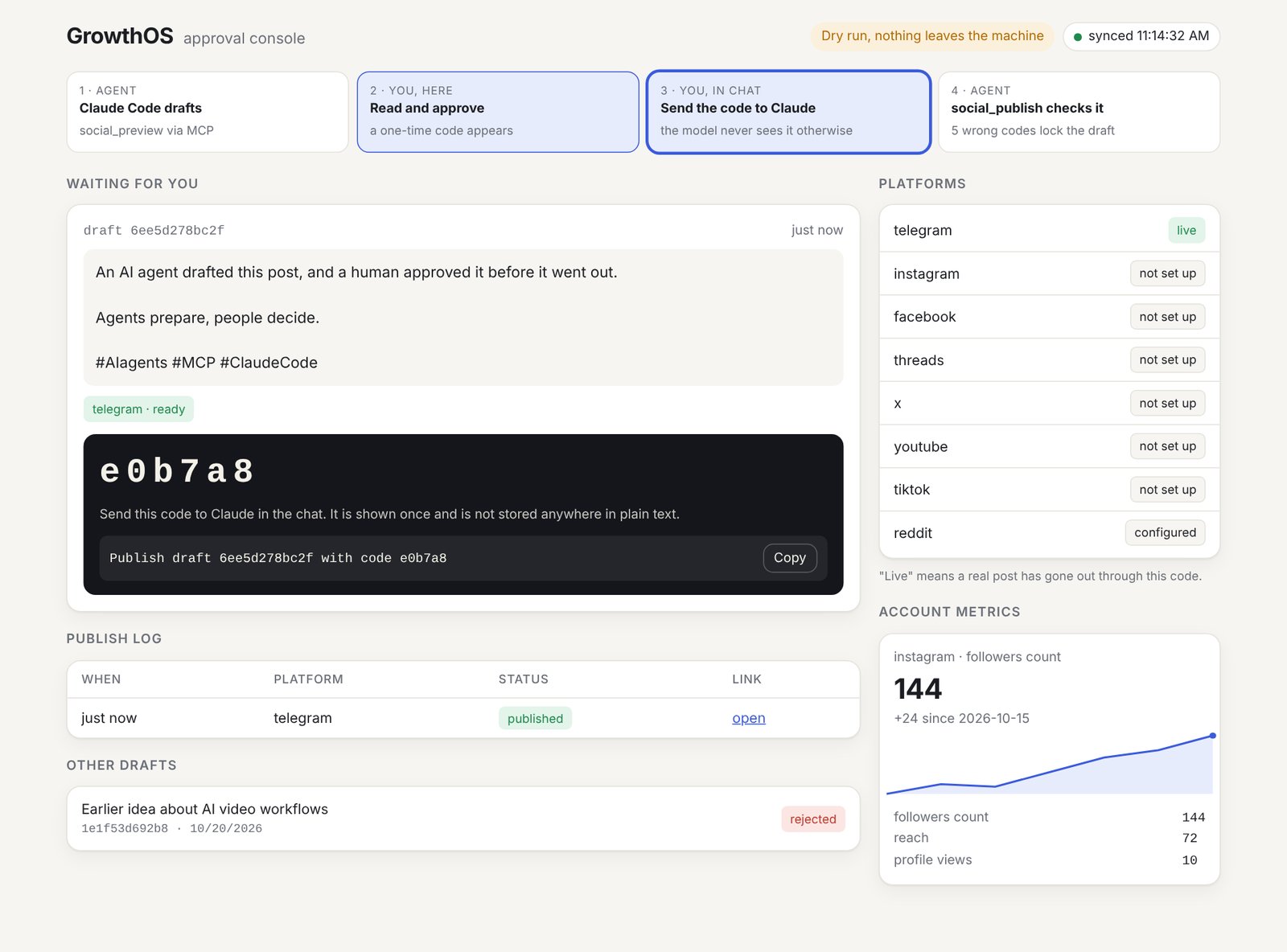
The approval console with sample data in dry-run mode: the draft an agent prepared, the one-time code shown only to the human, the publish log, which platforms have gone live and the collected account metrics.
Problem
An agent that can post is an agent that can post something you did not want, from an account people associate with you or your client. The usual answer is an instruction in the tool description: "only call this after the user approves". That is a convention, not a mechanism; the model is free to decide it has approval.
The second problem is the one small businesses actually have: publishing is not the goal. The goal is new customers, and knowing which actions brought them.
What GrowthOS is
GrowthOS is a marketing platform run for real clients, built as an MCP server that lets Claude Code prepare, review and publish content, with an approval console where a human decides. Two independent locks sit between the model and the audience.
you ask Claude Code for a post
  → social_preview   validates it per platform and stores an immutable draft, pending.
                     No code is returned: the model never sees one.
  → the console      you read the draft in the browser and press Approve;
                     a one-time code appears there, only its hash is stored
  → you              send that code to Claude in the chat
  → social_publish   publishes exactly that draft, and only with a matching code
The approval code is a value the model does not possess until a human hands it over. It is generated only when a person presses Approve, shown once, and stored as a SHA-256 hash. Five wrong codes lock the draft. A rejected draft cannot be published, and nothing leaves the machine unless a separate switch is on.
The loop it is built around
flowchart LR
  A["1. Audit: what exists and how it performs"] --> B["2. Strategy: audience, positioning, channels, promos"]
  B --> C["3. Execution: content, website, Google profile, DM handling"]
  C --> D["4. Measurement: which actions brought customers"]
  D --> B
For the first client, a Chinese restaurant in Tbilisi, the business goal is concrete: new local customers. A family deciding where to eat on Saturday finds a restaurant through Google Maps, a friend, a Facebook post or a delivery app, not only through Instagram, so the platform covers the whole loop rather than one channel.
What is built
- Publishing with approval: MCP tools for preview, publish, manual records, metrics and history; adapters for Telegram, Instagram, Facebook Pages, Threads, X, YouTube, TikTok and Reddit. Telegram and Instagram are verified live; the rest pass tests against mocked HTTP and are called untested, because the difference matters.
- Client isolation: one profile per client with its own env file, state directory, tokens, console port and MCP server entry. The platform refuses to start rather than mix two clients.
- Audits in code: read-only Instagram content inventory and comment reads, Facebook Page audit with paid versus organic views; results stay in the client's state directory, the repository holds aggregates only.
- Media pipeline: local files prepared per platform rules, uploaded to the client's own object storage only at publish time, after approval.
- Branded client console: a per-client overview and content screen fed by one hand-kept, sourced data file: KPIs with dated sources, channel status, blockers, what is waiting on the client.
- Daily metric snapshots to an append-only series, so "which post worked" becomes a question about change over time.
- Client knowledge in files: brief, audit, strategy, decisions, brand book generated in two languages from one template, KPI baseline with measurement windows and sources, and a progress report built from a data file where every figure carries its source and date.
What is not built yet
Campaign tracking that links content and promotions to customers, scheduling, DM handling for real guests (blocked by Meta App Review; drafts only until then), and the analytics loop beyond snapshots. The plan is written down in order and worked through one phase at a time.
What this project demonstrates
- Safety as a mechanism: the model cannot publish without a value only a human can produce.
- Claude Code as the operator: the platform is an MCP server plus skills and client context, not a chat wrapper.
- Multi-client from day one: isolation enforced in code before the second client exists.
- Evidence discipline: every number in the client's files has a source, a date and a measurement window; "verified live" is earned, not assumed.