ProbeForge · AI Field Electrician in Shadow Mode
An AI agent that reads the wiring drawing of a real transfer switch, chooses its own measurements and finds the root cause, under a safety policy enforced in code. Built solo for the Meta Global AI Developer Hackathon, Oct 26 to Nov 4, 2026.
The three-minute hackathon video: the outage, the transfer switch, and the agent finding the fault under a safety policy enforced in code.
Problem
A data center loses utility power. The generator starts, but the automatic transfer switch does not move the critical load onto it. The UPS carries the load, and it has minutes left. A technician has to find the fault from the controller's lights, a wiring drawing and a meter, without making anything worse: no bypassing interlocks, no paralleling sources, no operating the switch by hand under load.
Power is the leading cause of such outages. Uptime Institute's 2026 outage analysis puts power issues behind 45% of the most impactful outages, and one in five outages now costs more than $1 million.
What ProbeForge does
ProbeForge simulates that situation on a real piece of equipment, an ASCO Series 300 Group G transfer switch (redrawn from the vendor's wiring diagram, every part and net with its source), injects a hidden fault, and lets three diagnosticians work on it through the same tools and the same safety policy:
- Agent: Meta's Muse Spark with tool calling picks every reading and action itself and keeps an explicit hypothesis list.
- Hybrid v2: Muse Spark in three roles, each checked by deterministic code. It reads the drawing into a netlist (checked against the documented transfer sequence), repairs the reading when a measurement contradicts it (a repair is accepted only if the fault-free sequence still holds), and explains the result to the technician as structured output that code verifies: the diagnosed part is named, and the root cause comes before any part it damaged. Between those roles an information-gain planner chooses the readings.
- Engineer mode: a human does the same job on the same screen, optionally with the planner's suggestion. Shadow mode: the trace is marked as assisted.
Every reading or action passes the policy first. Risky actions wait for a human approval; some are never allowed. The UPS clock drains 30 seconds per reading, and a correct diagnosis after the UPS ran out is shown as what it is: critical load lost.
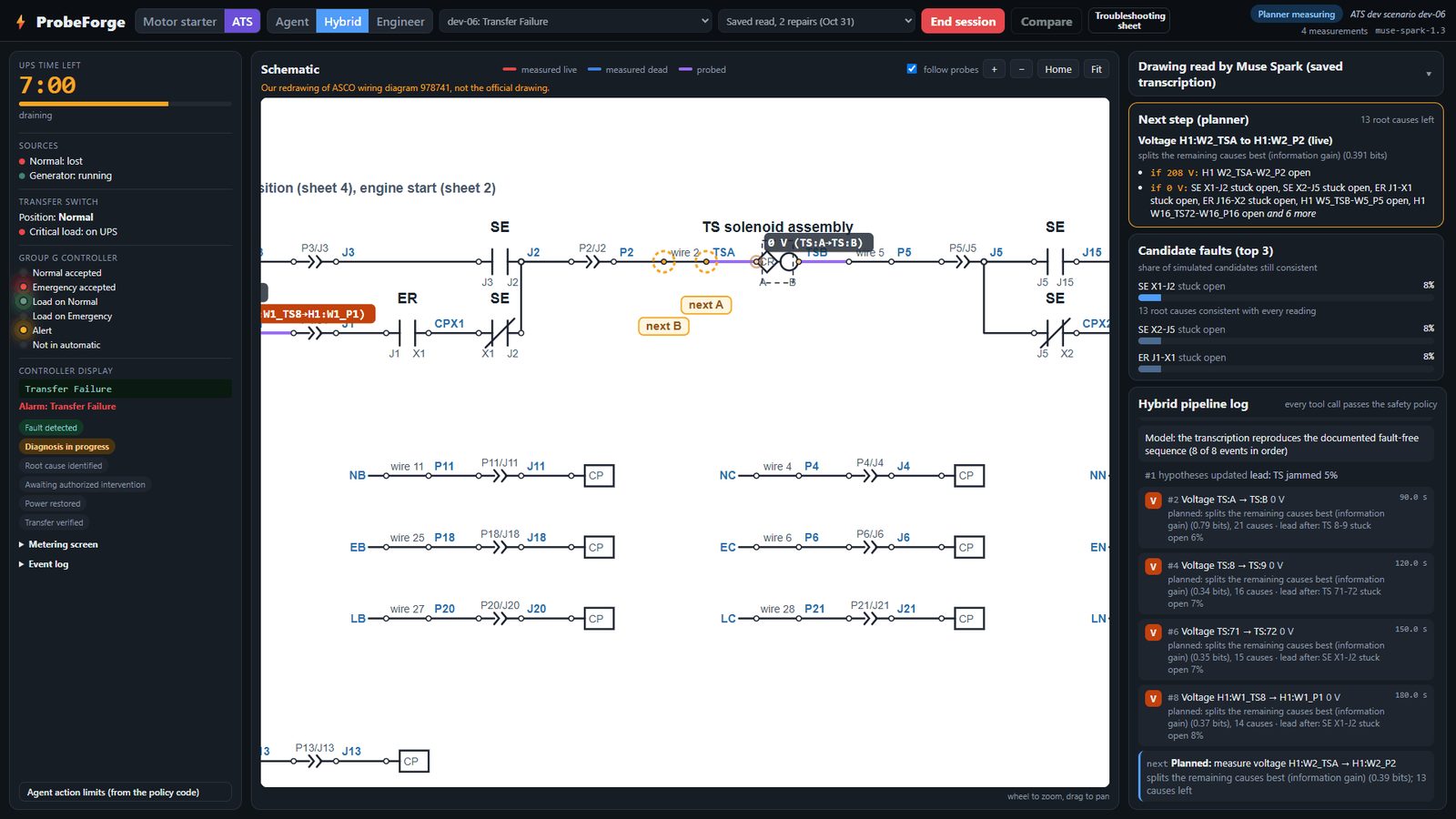
Hybrid v2 mid-run. The planner's next reading is ringed on the drawing and its card lists the causes each possible result keeps. The log records every reading with its policy check while the UPS clock drains.
Safety policy, enforced in code
The policy lives in code, not in the prompt. Blocked attempts return to the diagnostician as an error and are counted.
| Tier | Examples |
|---|---|
| Allowed | read the panel, event log, metering; measure voltage; resistance only with both sources isolated |
| Approval | isolate the sources while the load is not powered; manual operation check; repairs (isolated only) |
| Strong approval | isolate a powered load; restore or repeat a transfer after a Transfer Failure; the request must cite a reading and state the policy's facts to the approver |
| Never | bypass an interlock, parallel the sources, operate the handle under load |
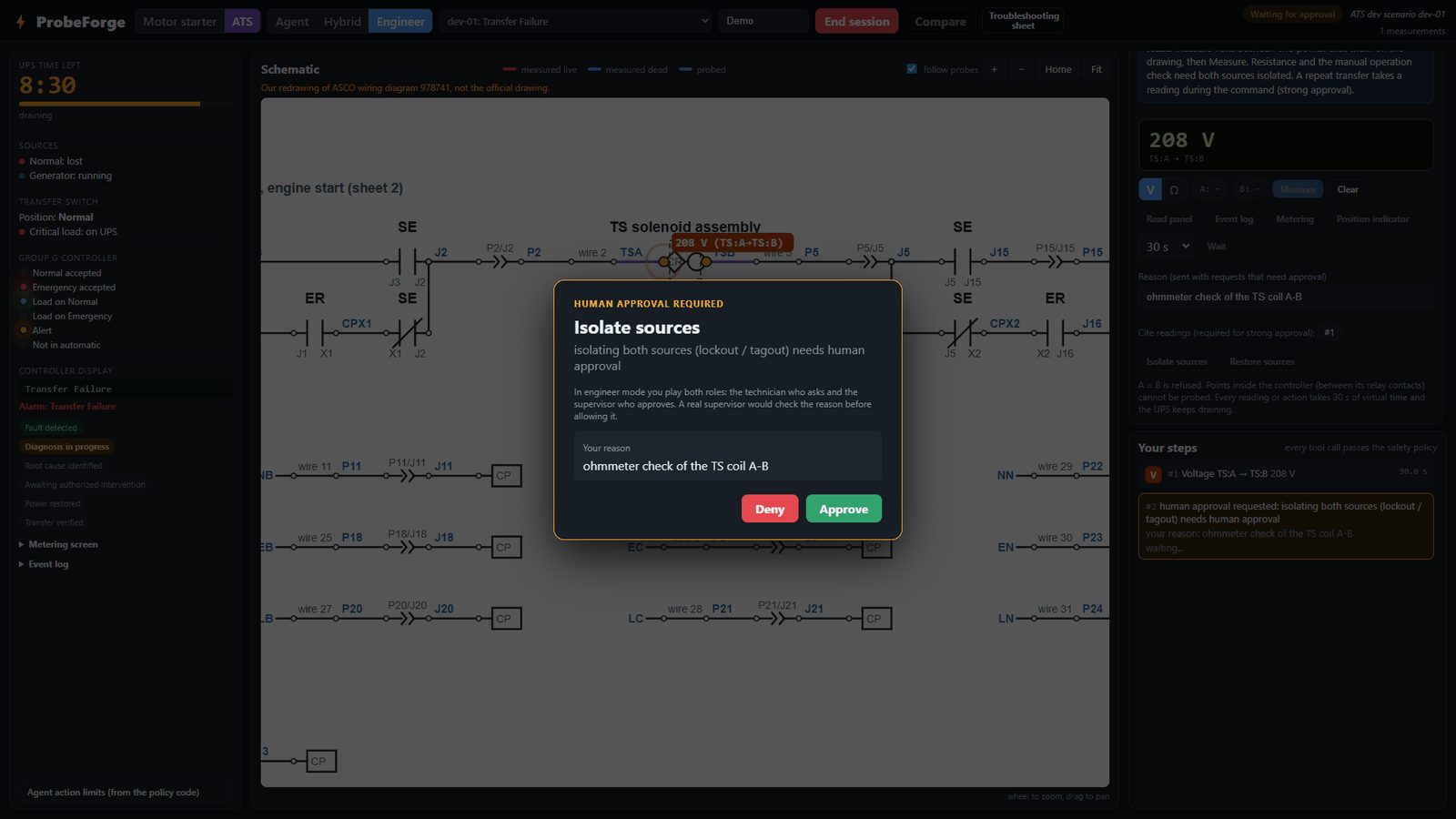
Engineer mode: isolating the sources for an ohmmeter check waits for a human approval, with the reason on the card.
Architecture
flowchart LR
  S["Simulated bench: sources, controller, mechanism, UPS, hidden fault"]
  T["Tool API: panel, meter, isolate, manual check, repeat transfer, repair"]
  P["Safety policy in code: allowed / approval / strong approval / never"]
  A["Agent: Muse Spark, tool calling"]
  H["Hybrid v2: information-gain planner"]
  D["Drawing sheets"] --> R["Muse Spark: read"] --> C{"Documented sequence check"}
  C -- contradicted --> RP["Muse Spark: repair"] --> C
  C -- holds --> H
  H --> E["Muse Spark: explain"] --> K{"Code check: names the part, root cause first"}
  A --> P
  H --> P
  P --> T --> S
  U["Human: approvals, Engineer mode"] --> P
  K --> W["Web UI: live drawing, log, result"]
The agent and the planner never see the injected fault: tests check the agent's prompt against all 118 catalog faults and verify that UI events carry the fault only in the final result. All model calls go to muse-spark-1.3 through the Meta Model API; the key stays server-side, and a metered client reserves an upper bound in a local ledger before every call so a run that fails midway still records what it spent.
Results
One holdout run on 28 faults nobody picked by hand, against the 12 dev cases. The holdout was protected the way an evaluation should be: the agent, tools, policy, bench, fault catalog, scoring and hybrid were frozen with 13 fingerprints first; the 28 cases were sampled by a fixed seed excluding every dev fault and their twins, and committed with their sha256 before any run. One run, no reruns, no changes.
| Agent dev | Agent holdout | Hybrid v2 dev | Hybrid v2 holdout | |
|---|---|---|---|---|
| Part-level correct | 10/12 | 17/28 | 10/12 | 18/28 |
| Confidently wrong | 0/12 | 3/28 | 0/12 | 0/28 |
| Insufficient information | 2/12 | 11/28 | 2/12 | 13/28 |
| Correct before the UPS ran out | n/a | 12/28 | 10/12 | 15/28 |
| Readings per case | 13.2 | 14.5 | 3.8 | 2.6 |
| Cost per case | $0.095 | $0.12 | $0.009 | $0.006 |
What it shows: the free-running agent was confidently wrong three times on unseen faults, once naming the burnt coil (the consequence) instead of the misadjusted contact (the root cause). The hybrid, with deterministic checks around the model, was never confidently wrong, never lost the load, and cost 20 times less per case. Eight position-feedback faults ended in "insufficient information" for every diagnostician: the load was powered, isolating it needs strong approval, and the batch rule denied it. That is the policy working as designed.
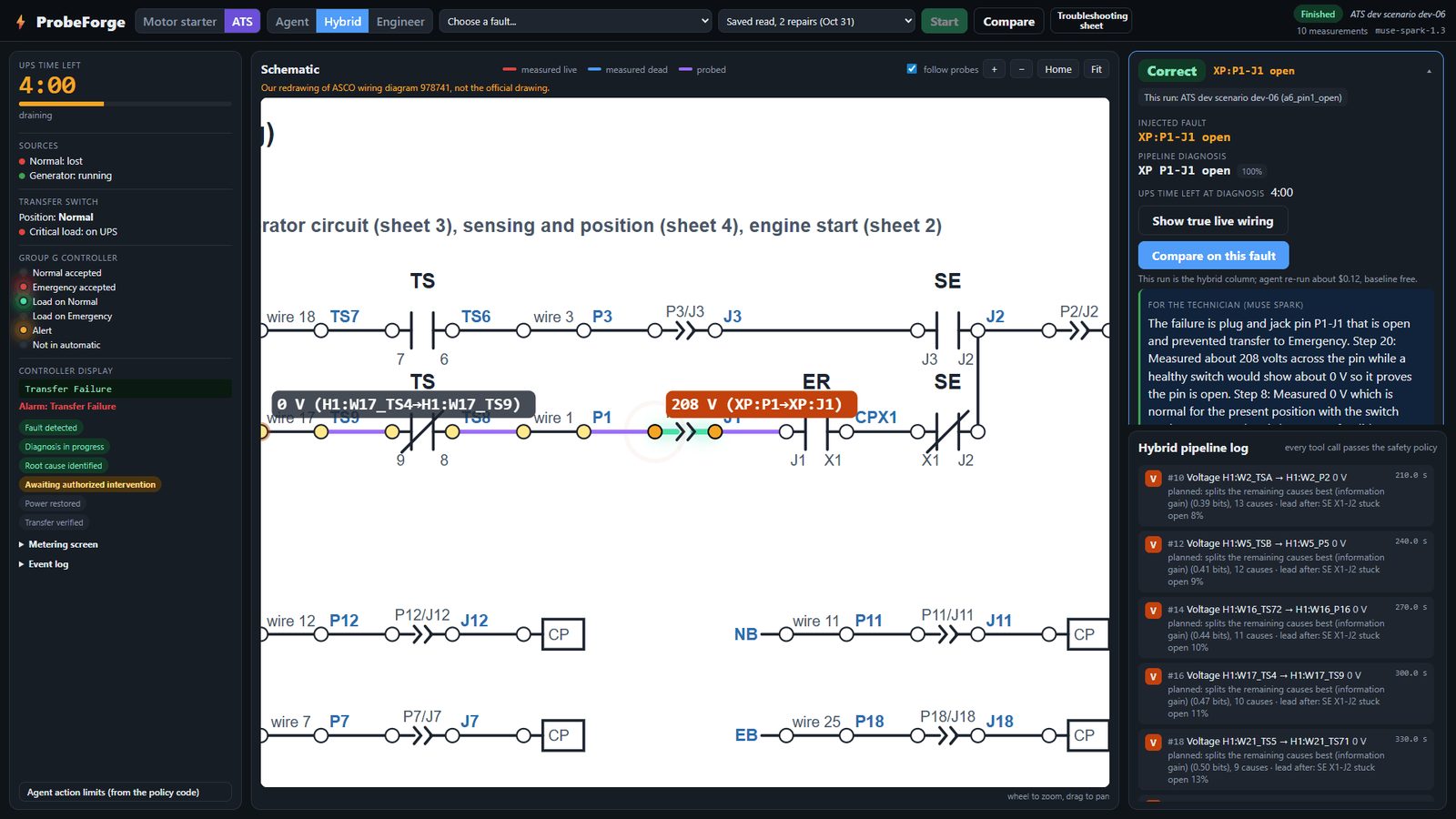
The result: the diagnosed part outlined on the drawing, the injected fault revealed only now, the UPS time left at diagnosis, and the model's explanation for the technician.
Limits, stated
- The hybrid pipeline was developed on this one drawing and the 12 dev cases. Generalization to other drawings is not shown.
- The ATS model and its assumptions have not been reviewed by an electrical engineer; undocumented behaviour is labelled as an assumption with its status and source.
- One run per diagnostician on 28 cases: small samples. The bench, the catalog and the sampler have the same author; independence rests on seeded sampling after the freeze.
- After the holdout an external review found three defects in the frozen code. They are fixed with new fingerprints and recorded, and the fixes were verified offline against the original tool logs (120 of 120 identical).
What this project demonstrates
- Agents under a policy, not a prompt: the same tool layer and safety tiers for the model and the human, with approvals that must cite evidence.
- Deterministic checks around the model: reading, repair and explanation each pass a code check before anything is shown or acted on.
- Honest evaluation: frozen components, a sealed holdout, one run, every decision with its evidence in a public decisions log.
- Cost discipline: a spend ledger with reservations, per-run and daily caps; the whole project cost about $56 in model calls.
- Shipping: a web UI, a public demo deployed with Docker Compose behind Caddy, and a CI pipeline, built solo in ten days.