Retail Shelf Recognition
Production multimodal recognition of products on store shelves: GroundingDINO, Qwen-VL OCR, Qdrant retrieval, DINOv2 and ArcFace, deterministic fusion, guardrails and explicit unknowns.
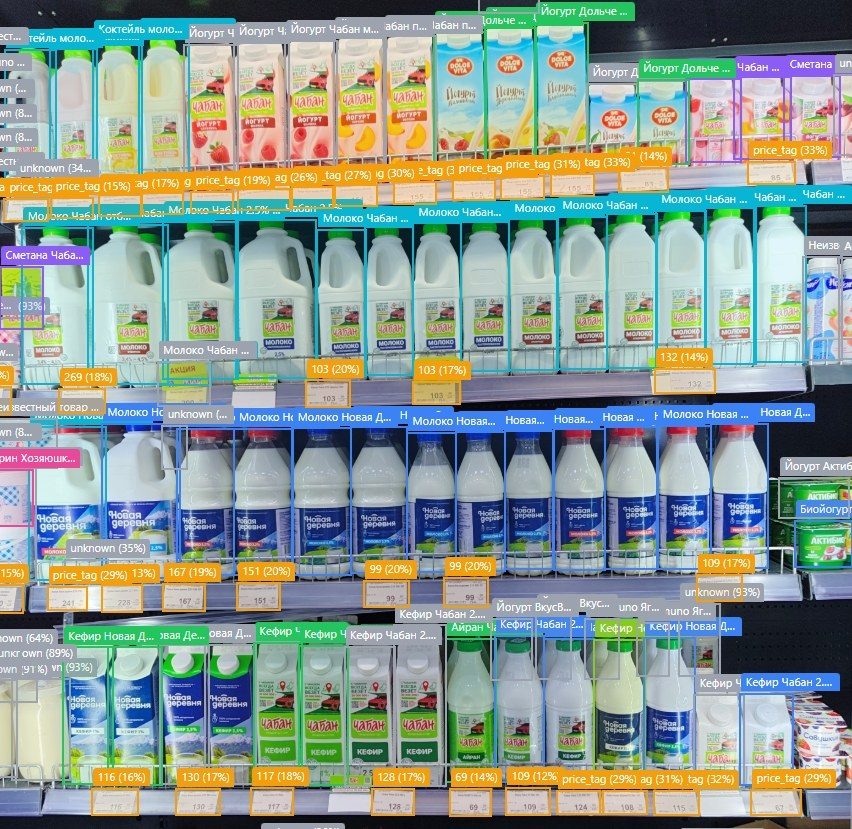
Real shelf output: localized packs, brand/SKU labels, price-tag
reads and explicit unknown when the evidence is not strong
enough.
Status
This is production engineering with a pilot business rollout.
- 6,145+ shelf photos processed in the merchandising subsystem.
- 5,882 completed analyses in the audited production queue.
- Current rollout: 40 retail outlets / 3 merchandising users.
- ~320k OCR calls processed by the production service.
- ~108k ArcFace shadow evaluations recorded.
The engineering pipeline is live; the organizational rollout is still intentionally limited.
Problem
A shelf photo has to become trustworthy commercial data:
- share of shelf — own brand vs competitors;
- assortment coverage — which brands/SKUs are present;
- package / format / size mix;
- price-tag evidence;
- inputs for merchandising review and execution analytics.
The difficult cases are not obvious detections. They are visually similar sibling products that differ only by weight, fat percentage, flavour, label detail or package format.
For this problem, a confident wrong own-vs-competitor decision is
worse than returning unknown. The system is therefore
designed around evidence, abstention and reproducible
post-mortems, not maximum forced coverage.
There is also a non-model problem: retail capture happens under weak connectivity, app interruption and device restarts. A model pipeline is not production-ready if the field user cannot reliably create and synchronize the input data.
End-to-end production architecture
Native Android field terminal
  → Room-backed durable photo queue
  → network-aware WorkManager synchronization
  → ingest API
  → object storage + durable analysis queue
  → async analysis worker
  → GroundingDINO detection
  → Qwen2.5-VL OCR / package reading
  → Qwen3-Embedding-8B
  → Qdrant dense text retrieval
  → attribute-aware reranking
  → DINOv2 visual k-NN
  → fine-tuned ArcFace metric retrieval
  → deterministic signal fusion
  → evidence guardrails
  → SKU / brand / unknown
  → share-of-shelf / assortment / competitor analytics
The production AI stack is self-hosted on owned NVIDIA H200 infrastructure.
The LLM does not choose the final SKU. It extracts textual and package evidence; the final identity is selected by a deterministic decision layer that combines independent retrieval and visual signals.
Field product — offline-first Android terminal
The merchandising terminal is a native Kotlin / Jetpack Compose application built for actual store conditions rather than a thin camera screen.
Durable work before upload
Captured photos enter a Room-backed local queue with the shelf/display and capture context needed for delayed delivery. The field user can keep working before the network request or GPU analysis finishes.
The queue supports:
- pending / upload / failure state visible to the user;
- per-photo retry and delete;
- bulk send;
- periodic synchronization through WorkManager;
- immediate retry when connectivity changes from offline to online;
- recovery of records left in an in-flight state after process/device interruption.
The recovery path is important: a mobile process can die mid-upload,
so UPLOADING cannot be treated as an eternal terminal
state.
Offline shelf registry
Later iterations moved more than the media queue offline. The application caches the shelf/display registry in Room and can fall back to the local copy when the API is unavailable. Cover images use disk caching and can be pre-warmed after connectivity returns.
Actions that require authoritative server state are explicitly guarded while offline rather than pretending every mutation succeeded locally.
Analysis vs planogram mode
The same field application distinguishes normal analysis capture from planogram work.
A merchandiser can move through:
store → shelf/display → capture → local queue → analysisor:
store → shelf/display → planogram image → shelf-zone annotation → syncThe on-device shelf-zone editor supports drawing regions over an image, dragging existing regions and resizing them with edge/corner handles. This keeps structured correction close to the physical shelf, where the scene is easiest to understand.
Why this matters to the AI system
Capture, upload and inference are independent stages. Temporary store connectivity or a busy model server does not block the merchandiser from taking the next shelf photo.
→ Detailed offline field-terminal case study
Ingest & provenance
The ingest layer provides:
- authenticated photo upload;
- SHA-256 duplicate protection;
- object storage for media;
- durable analysis queue;
- asynchronous workers;
- production provenance linking analysis to code/config revisions.
This separates field capture from GPU inference and preserves enough context for delayed processing and later post-mortems.
Analysis jobs run through a PostgreSQL queue using
FOR UPDATE SKIP LOCKED, with up to 3 attempts and automatic
recovery of jobs stuck for more than 30 minutes.
Detection
GroundingDINO localizes product regions before recognition. Earlier detector work also included closed-set / YOLO experiments and deduplication logic for contained, overlapping and shelf-band false-positive regions.
A separate detector track improved measured F1 from 0.68 → 0.91 on unseen shelf photos.
Detection is treated as one stage of the recognition system rather than the final business metric: a good box can still become an incorrect SKU, so downstream retrieval/evidence gates remain mandatory.
OCR / VLM evidence
Each product crop is read by self-hosted Qwen2.5-VL-72B-AWQ served through vLLM.
The VLM extracts evidence such as:
- brand text;
- product-name fragments;
- weight / volume;
- fat percentage;
- flavour/category clues;
- package-form clues.
OCR/VLM output is evidence for retrieval and guardrails. It is not trusted as a final classifier.
Dense retrieval
Catalog representation
Each retrieval entry is represented as structured product text combining attributes such as:
brand + name + category + subcategory + flavour + fat% + weight + volume + package_type + visual_markers
Embeddings are produced by a self-hosted Qwen3-Embedding-8B service.
Qdrant search
For each detected crop:
- OCR/VLM produces the available text evidence.
- The query is embedded with Qwen3-Embedding-8B.
- Qdrant performs cosine dense retrieval.
- Production retrieval depth is top-20.
- Reliable brand evidence can activate brand-filtered candidate narrowing.
- Candidates are reranked with structured attributes such as brand, weight, fat percentage, category and package evidence.
The embedding vector is 4096-dimensional and normalized.
The production vector collection contains 1,345 retrieval entries. The broader merchandising catalog contains approximately 1.5k own + competitor SKUs, so not every merchandising catalog record is necessarily represented identically in the vector collection.
Multimodal retrieval
Dense text retrieval is only one path.
In parallel, the production system uses:
- DINOv2 ViT-L/14 for general visual embeddings and k-NN retrieval;
- a fine-tuned ArcFace metric-learning encoder for independent visual votes;
- OCR-derived brand and product-attribute evidence;
- package-form evidence for ambiguous families.
The working galleries are on the order of tens of thousands of confirmed/reference crops (approximately 18.9k DINOv2 confirmed crops and 9.1k ArcFace references in the audited retrieval configuration).
A typical decision ladder can look like:
OCR brand + visual agreement
→ OCR brand + dense retrieval
→ strong dense retrieval
→ dense retrieval + independent visual support
→ visual retrieval
→ weak evidence
→ unknown
Every final prediction stores enough provenance — decision path, scores, thresholds and supporting signals — to reconstruct why the system made that decision.
Deterministic fusion and guardrails
The acceptance layer is deliberately conservative.
Examples of production guardrails include:
- OCR brand verification;
- competitor protection to reduce own/competitor contamination;
- retrieval-evidence gates requiring independent support for weak candidates;
- package-form protection for bottle / canister / carton ambiguity;
- ArcFace rescue when the metric-learning signal is stronger than the primary visual path;
- price-tag / promo rejection so non-product regions do not enter product metrics;
- sibling / weight evidence where available.
Low-evidence cases become unknown
instead of being forced into a SKU.
That abstention is part of the product design: share-of-shelf and assortment numbers are only useful if the system is allowed to say that it does not know.
Evaluation as production architecture
Evaluation is not a notebook step performed after model training. It is part of the release path.
The system uses:
- human-labelled golden sets;
- stratification by failure mode;
- grouped / cross-store validation to reduce leakage;
- distractor and hard-negative sets;
- Recall@1 / Recall@5 for retrieval tracks;
- FPR-anchored precision calibration;
- Wilson confidence intervals for small strata;
- pre-registered acceptance / kill thresholds;
- a 47k-box production replay harness that imports the real production decision module;
- shadow tables / candidate-model telemetry;
- nightly regression checks.
Candidate changes are promoted through:
off → shadow → activeThis process has rejected rerankers and encoder replacements that looked promising locally but weakened controlled production evaluation.
Measured results
End-to-end
- Brand precision: 95.8% on the confirmed end-to-end golden set.
- SKU precision: 73.1% end-to-end.
- Bare retrieval alone was approximately 29% SKU precision before the full cascade, independent visual evidence and guardrails.
Retrieval / metric learning
- Fine-tuned ArcFace cross-store Recall@1: 84.1% on the audited benchmark.
- DINOv2 baseline on the same benchmark: 26.4% Recall@1.
- Human readability ceiling on the unresolved tail: 76.4% ± 5.8 pp under a blind, pre-registered protocol.
Production telemetry
- ~320k OCR calls processed.
- ~108k ArcFace shadow evaluations.
- 6k+ shelf photos in the merchandising system.
- 5,882 completed production analyses in the audited queue.
Business outputs
Recognition results are not the end product. They feed a merchandising dashboard in the Chaban2 platform:
- Share of shelf — own vs competitor share by facings, per photo, store and brand; stores below 30% own share are flagged; shelf position (top / eye / middle / bottom) is recorded.
- SKU presence — for each own SKU: in how many analysed stores it was found, its facings, and a good / warning / critical status.
- Price intelligence from price tags — own average shelf price vs the market, a price index, per-category comparison with competitor brands and price spread across stores.
- Store markup — shelf price vs base price per store and SKU, with a high / normal / low markup status.
- RRP vs shelf price — recommended retail prices compared with the prices actually read from price tags.
- Assortment coverage — which own products and attributes are covered in each store, with coverage gaps and competitor presence.
Dashboard data is scoped by team: a manager sees only the stores of their team.
Human-in-the-loop improvement
Low-evidence crops go to an unknown inbox
(new → reviewed → promoted / excluded) together with the
crop, OCR text, visual candidates and a VLM suggestion. A reviewer
assigns the product, and promoted crops are added to the confirmed
visual gallery used for DINOv2 visual re-ranking (enabled by a feature
flag). The system improves on its own failure cases without retraining a
model.
Store compliance and monitoring
- Drift-based compliance — after each store visit,
the shelf is compared with that store's own recent history (median and
IQR over previous visits). Rules flag a drop in own share of shelf or
missing anchor products, and stores are ranked
ok / warning / critical / insufficient_data, critical first. - Operational alerts — every 15 minutes a monitor checks photo flow, the share of unknown products and pipeline health, and alerts the team chat.
Not implemented: comparison against a reference planogram image, and business alerts such as "own share dropped in store N". Report export is also not in production.
What this is — and is not
This is a production retrieval-augmented recognition system embedded in a field workflow.
It is not a classic document-question-answering RAG application:
- retrieved catalog candidates do not become documents for an LLM answer;
- the LLM does not generate the final SKU identity;
- there is no document-citation path in production;
- final identity comes from explainable fusion of retrieval, visual and attribute evidence.
For this business problem, deterministic fusion and calibrated abstention provide stronger control than asking an LLM to make the final identity decision.
My role
For the broader AI Chaban2 platform I was Head of AI and Technical Owner / platform architect: I built the first production versions hands-on, then hired and led a team of 7 engineers who extended them.
For this merchandising subsystem I owned the technical architecture and production rollout and was hands-on in:
- retrieval / matching architecture;
- OCR/VLM and embedding services;
- Qdrant retrieval and attribute reranking;
- multimodal fusion and guardrails;
- golden sets, replay evaluation and kill criteria;
- metric-learning evaluation;
- production inference / rollout methodology;
- end-to-end field-to-analysis architecture and operational tooling around the pipeline.
The broader commercial platform and mobile application were extended by the team I led; this repository focuses on this subsystem and the technical work I did on it personally.
Stack
Python · FastAPI · PyTorch ·
GroundingDINO · Qwen2.5-VL-72B-AWQ ·
Qwen3-Embedding-8B · Qdrant ·
DINOv2 ViT-L/14 · ArcFace · vLLM
· PostgreSQL · MinIO / S3-compatible storage ·
Kotlin · Jetpack Compose · Room ·
WorkManager · Coil · Docker ·
systemd / cron · NVIDIA H200
Runnable examples
Production code and commercial data are private, but this repository includes small runnable examples of the decision-logic shape and evaluation discipline:
python3 examples/fusion_demo.py
python3 examples/evaluate.py
fusion_demo.py walks synthetic crops through
priority-ordered fusion, including abstention paths.
evaluate.py demonstrates precision/recall/F1, abstention
rate and why naive random splits can inflate metrics on correlated shelf
crops.
Deep dives
- Offline field terminal — durable mobile queue, reconnect recovery, shelf cache and planogram zones.
- Expert-readability ceiling — blind protocol, ceiling calculation, intervals and limitations.
- Evaluation honesty — population-level validation and grouped splits.
- Production lessons — shadow rollout, pre-registered gates and config-drift prevention.
- Metric learning — ArcFace shelf retrieval, gallery doctrine and rejected candidates.
Related work
Author: Eduard Kharaev — GitHub profile · haraev87@gmail.com · Telegram @Edharaev
I'm based in Tbilisi and open to new roles. Email haraev87@gmail.com or message me on Telegram.